

Title: The Science of Timber Stability: The Phases and Process of Wood Kiln-Drying
In the high-end B2B furniture manufacturing sector, the true mark of luxury craftsmanship is invisible to the naked eye. While international buyers easily evaluate sleek design silhouettes and flawless surface lacquers, the longevity of a solid wood table is determined long before it hits the assembly line. The critical foundation lies in how the raw timber is seasoned.
Freshly harvested logs from Indonesian plantations contain a massive volume of water, often exceeding a Moisture Content (MC) of 50% to 100%. If a factory manufactures furniture using raw, wet wood, the laws of physics will inevitably destroy the product. As the furniture encounters dry, heated indoor air in overseas markets like Europe or North America, the wood will release its internal moisture rapidly, resulting in catastrophic cracks, split joints, and warped surfaces.
To prevent these liabilities, establishing a rigorous, scientific wood kiln-drying process is an absolute requirement.
At Tripoin Furniture, we operate state-of-the-art computerized kiln chambers to carefully extract moisture from premium hardwoods like Teak, Mahogany, and Mindi. Here is a detailed breakdown of the technical timber seasoning stages required to engineer world-class, export-ready furniture.
Stage 1: Pre-Kiln Air Seasoning (Natural Stacking)
The journey begins at our timber yards. Once raw logs are sawn into uniform planks, they are not immediately thrust into the intense heat of a kiln chamber. Doing so would cause immediate thermal shock, destroying the wood fibers.
Instead, the lumber enters the Air-Seasoning phase. Planks are stacked using thin wooden separators (stickers) placed at precise intervals to allow continuous, uniform airflow between every layer. The timber is left in a covered yard for several weeks to let the intense tropical atmosphere evaporate the “free water” (liquid water inside the cell cavities) naturally. This safe, cost-efficient phase brings the initial MC down to roughly 20% to 25%.
Stage 2: Kiln Loading and Initial Warm-Up
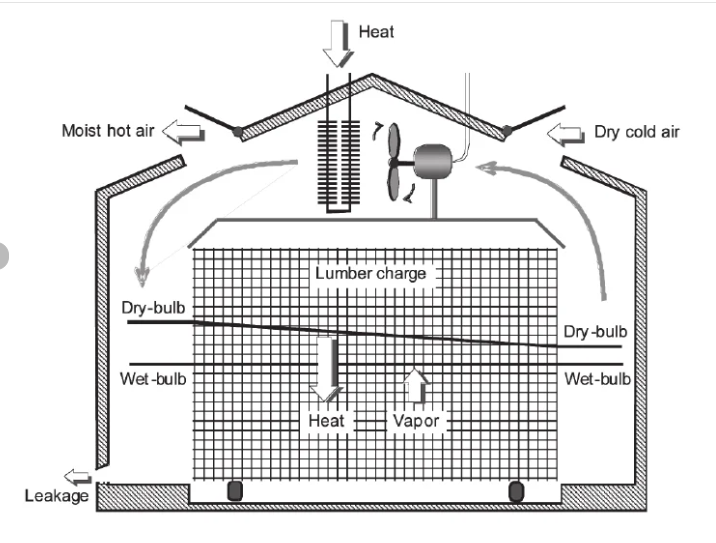
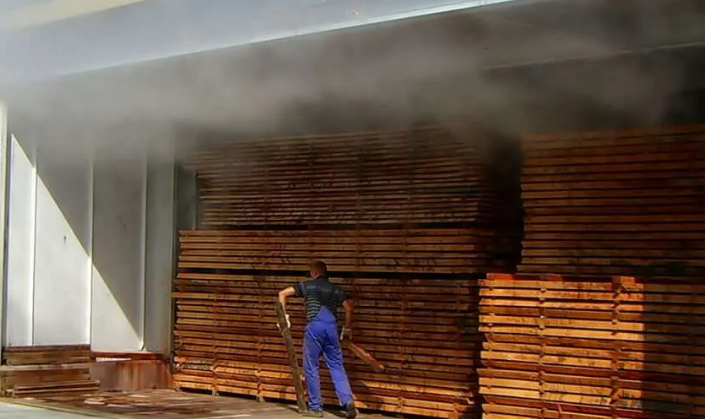
Once the timber reaches its air-dried baseline, it is loaded into our sealed kiln-drying chambers. Our quality control engineers insert digital moisture probes deep into sample boards throughout the stack to monitor the core moisture in real-time.
The chamber then initiates the Warm-Up phase. The temperature is increased slowly, alongside a high relative humidity level controlled by steam injection. By raising the temperature while keeping the air humid, we warm the wood right to its core without allowing the outer surface to dry too fast. This crucial stage prepares the timber cellular walls for safe moisture extraction.
Stage 3: The Controlled Drying Phase (Extracting Bound Water)
This is the most critical and complex stage of the process, governed by a strict scientific software drying schedule tailored specifically to each wood species and board thickness.
During this phase, the kiln program slowly raises the temperature while lowering the relative humidity. The kiln forces the “bound water” (moisture chemically trapped within the cell walls) to migrate from the damp center core out to the dry surface, where it is instantly evaporated and drawn out by high-velocity directional fans.
- The Zero-Defect Rule: If the outer surface dries faster than the core can release its water, the wood undergoes “casehardening”—a technical defect where the outer shell shrinks and locks up, trapping moisture inside and causing deep internal splits (honeycombing). Our automated systems adjust the temperature hourly to keep the drying gradient perfectly balanced.
Stage 4: Conditioning and Stress Equalization
As the timber approaches our strict target of 8% to 12% Moisture Content (MC), the internal stresses of drying must be fully released. Different parts of a wood board inevitably retain minor moisture variations.
To equalize the timber, the kiln enters the Conditioning phase. We slightly raise the humidity inside the chamber one last time, allowing the over-dried outer surfaces of the wood to re-absorb a microscopic amount of moisture until the entire board achieves a perfectly uniform Equilibrium Moisture Content (EMC) from core to surface. This step effectively locks the wood’s dimensions into a permanent state of stability.
Stage 5: Cooling Down and Final QC Audit
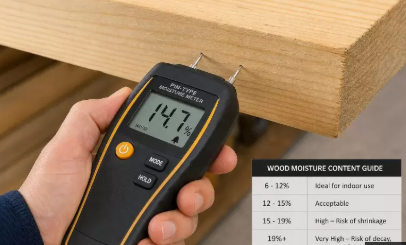
Finally, the heat is shut off, and the kiln cools down slowly to match the ambient outdoor temperature. The timber is then moved to a dry storage warehouse to rest for 48 hours before machining begins. Our quality control team conducts a mandatory final audit using pin-type moisture meters across every single batch to certify that zero wet wood enters our production tracks.
Conclusion: Secure Your Brand with Engineered Stability
Investing in a rigorous, multi-week wood kiln-drying process is what separates entry-level residential furniture from export-grade commercial assets. By systematically extracting moisture down to the global golden standard of 8% to 12% MC, Tripoin Furniture eliminates the risk of structural wood movement, giving your brand absolute peace of mind across any climate zone worldwide.
Are you compiling an RFQ or reviewing structural quality assurance metrics for your next custom hospitality furniture line? Contact Tripoin Furniture today to consult with our industrial design engineers, view our kiln logs, and request a professional B2B quote.
TRIPOIN FURNITURE
Email : sales@tripoinfurniture.com