
Understanding Wood Moisture Content (MC) and Equilibrium Moisture Content (EMC) for Safe Furniture Exports

Understanding Wood Moisture Content (MC) and Equilibrium Moisture Content (EMC) for Safe Furniture Exports
Learn how Wood Moisture Content (MC) and Equilibrium Moisture Content (EMC) impact wooden furniture exports from Indonesia, and how Tripoin Furniture prevents cracking and warping across global climates.
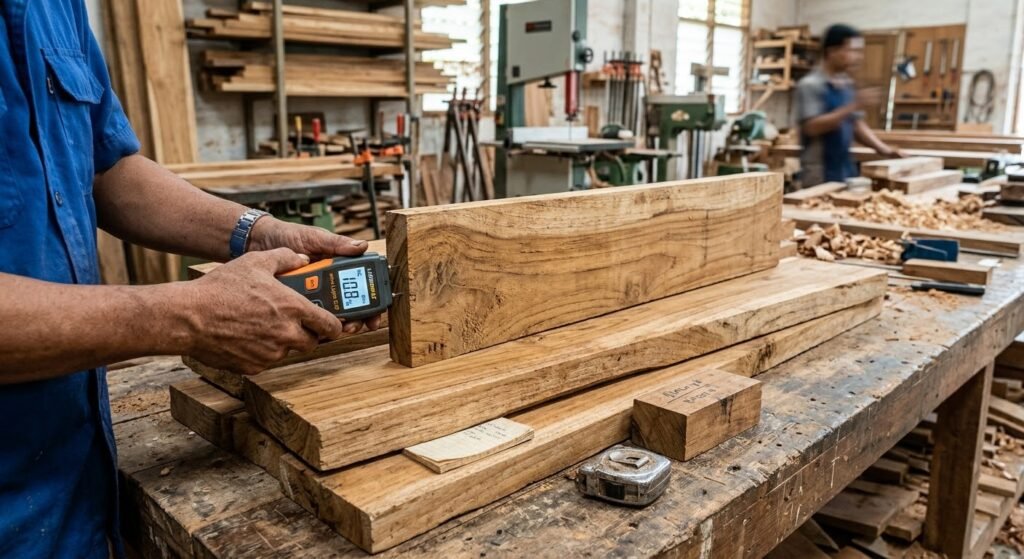
Shipping solid wood furniture from Indonesia to international markets presents a unique environmental challenge. Indonesia has a warm, tropical climate with high humidity. Meanwhile, destinations in North America, Europe, or the Middle East experience vastly different temperature and humidity levels—often including dry winters and indoor heating.
Without strict moisture control, wooden furniture can crack, warp, or split shortly after arriving at its destination. At Tripoin Furniture, understanding and managing Moisture Content (MC) and Equilibrium Moisture Content (EMC) is a core part of our export-ready manufacturing process in Jepara.
What is Wood Moisture Content (MC)?
Wood is a hygroscopic material. This means it acts like a natural sponge, constantly absorbing and releasing moisture from the surrounding air.
Moisture Content (MC) refers to the weight of water contained in a piece of wood, expressed as a percentage of the wood’s completely dry (oven-dry) weight. Freshly cut timber from Indonesian forests can have an MC of 50% to over 100%. Before that timber can be turned into export-grade furniture, most of this water must be carefully removed.
What is Equilibrium Moisture Content (EMC)?
Equilibrium Moisture Content (EMC) is the point at which wood stops gaining or losing moisture because it has reached a balance with the temperature and relative humidity (RH) of its surrounding environment.
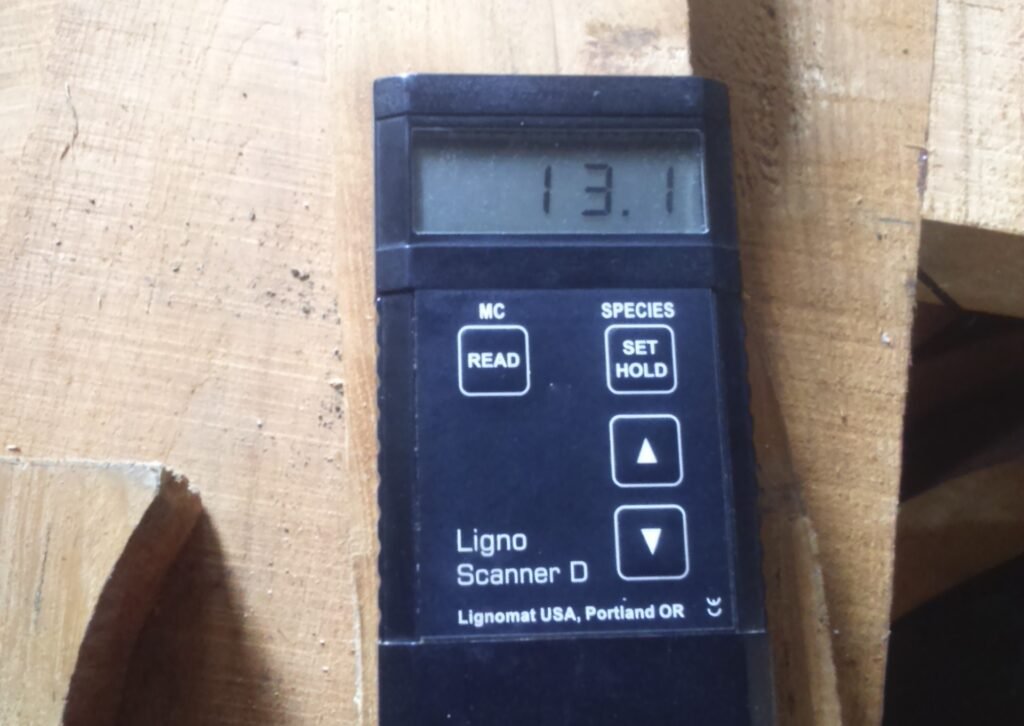
Because climate conditions vary worldwide, the EMC of wood changes depending on where the furniture is located:
- Indonesia (Tropical Climate): High relative humidity (75%–85%) results in a natural outdoor EMC of roughly 15% to 18%.
- North America & Europe (Indoor Environments): Heated interiors during winter or air-conditioned spaces often have low relative humidity (30%–50%), resulting in an EMC of 6% to 10%.
- Arid Regions (e.g., Middle East): Extremely dry conditions can push indoor EMC down to 5% to 8%.
The Relationship Between MC and EMC in Furniture Exports
Problems occur when there is a large gap between the wood’s MC during manufacturing and the EMC of the destination country.
If a dining table is built in Jepara using wood at 15% MC and shipped to an air-conditioned showroom in New York or a heated home in Germany (where the EMC is 8%), the wood will rapidly release moisture into the dry air. As the wood loses water, it shrinks. Uneven shrinkage puts immense stress on wood fibers and joinery, leading to:
- Surface checking and deep cracks
- Warping, cupping, or bowing of tabletops
- Loose joints and failing glue lines
Practical Applications at Tripoin Furniture

To guarantee that our OEM and custom furniture pieces arrive safely and last for decades, Tripoin Furniture applies strict moisture management protocols at every stage of production:
- Precision Kiln Drying (KD): We do not rely solely on air drying. Our raw timber—such as teak, mahogany, and mindi—is placed in controlled Kiln Dry (KD) chambers. We dry the wood down to a target MC of 8% to 12%, aligning it closely with the indoor EMC of major international markets.
- Acclimatization and Conditioning: After kiln drying, timber is stored in conditioned areas to equalize moisture distribution throughout the core and surface of the boards before cutting and shaping begin.
- Continuous MC Testing: Our quality control team uses calibrated pin and pinless moisture meters at multiple checkpoints—upon timber arrival, after kiln drying, before assembly, and prior to finishing. Any board outside the target range is rejected or re-dried.
- Smart Joinery and Construction: Wood naturally expands and contracts slightly with seasonal humidity shifts. Our craftsmen use export-standard construction techniques—such as breadboard ends, floating panels, and slotted screw holes—that allow the wood to breathe without splitting.
- Protective Finishing and Export Packaging: High-grade sealers and topcoats slow down the rate of moisture exchange during ocean transit. During container loading, we utilize desiccants (moisture absorbers) and protective wrapping to shield the cargo from sudden humidity spikes at sea.
Partner with an Export-Ready Manufacturer
Managing wood moisture is not just technical theory—it is essential insurance for international furniture brands, distributors, and hospitality projects. By bridging the gap between Indonesia’s tropical climate and global indoor environments, Tripoin Furniture ensures consistent quality from our factory floor in Jepara to your customers’ spaces.
Looking for a reliable OEM furniture partner in Indonesia?
Explore our collections at www.tripoinfurniture,com or contact our team at sales@tripoinfurniture.com to discuss your custom production standards and target market requirements.